
Commercial HVAC Installation in Glenview, IL
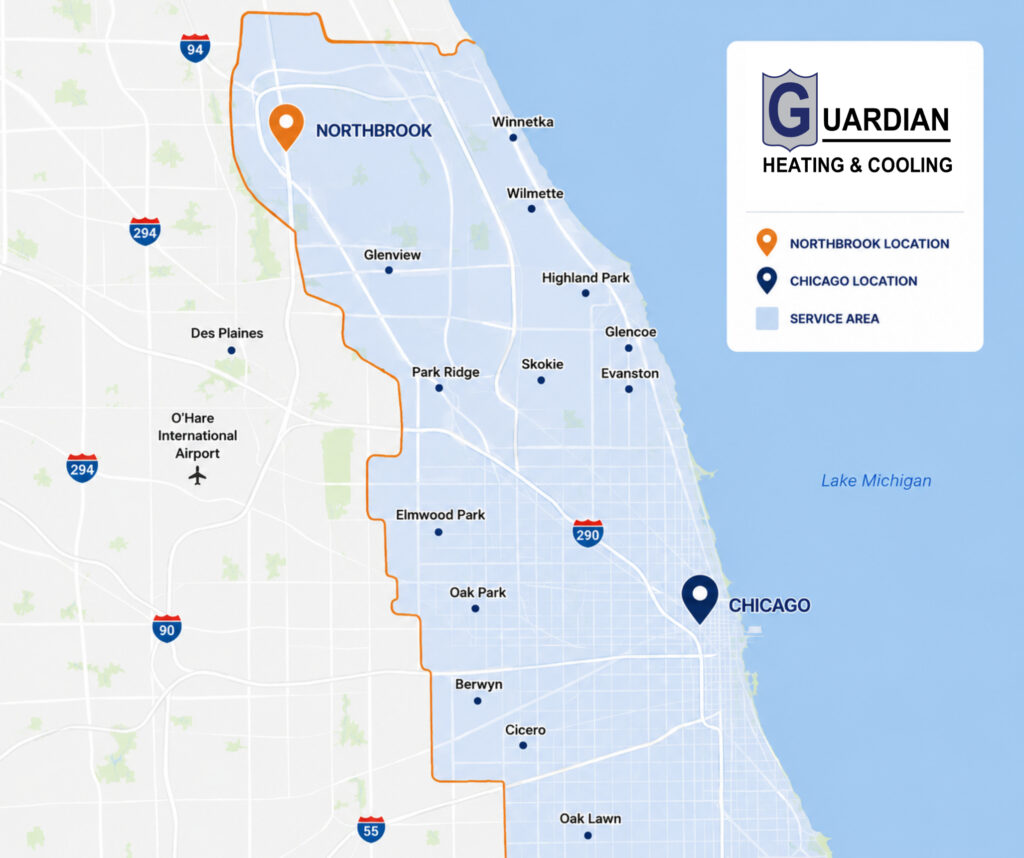
When your Glenview business requires a new commercial HVAC system, the installation process demands expertise, precision, and a deep understanding of both your building’s unique characteristics and your operational needs. At Guardian Heating & Cooling, we’ve been proudly serving up comfort all across Chicagoland since 1953, bringing decades of experience to every commercial HVAC installation project we undertake.
Commercial HVAC installation encompasses far more than simply placing equipment on a rooftop or in a mechanical room. The process involves careful load calculations, ductwork design, zoning strategies, and integration with existing building systems. In Glenview’s diverse commercial landscape, from retail spaces along Waukegan Road to office complexes near The Glen, each installation presents unique challenges that require customized solutions.
Understanding Commercial HVAC System Requirements
The foundation of any successful commercial HVAC installation begins with a comprehensive assessment of your building’s heating and cooling demands. This evaluation considers multiple factors including square footage, ceiling heights, window placement, insulation quality, and occupancy patterns. For a typical 20,000-square-foot office building in Glenview, cooling loads can range from 60 to 80 tons, while heating requirements vary significantly based on building envelope efficiency and usage patterns.
We analyze your facility’s thermal characteristics using advanced load calculation software that accounts for Glenview’s climate data, including summer design temperatures reaching 91°F and winter lows dropping to -8°F. These calculations ensure your new system provides adequate capacity without oversizing, which can lead to short cycling, poor humidity control, and increased energy costs. Our family oriented business is large enough to service all makes and models of equipment, yet small enough to care about getting these critical details right for each client.
Equipment Selection and Sizing Considerations
Selecting the appropriate HVAC equipment for your commercial space involves evaluating numerous options across different manufacturers, efficiency ratings, and system configurations. Rooftop units remain popular for many Glenview businesses due to their space-saving design and ease of maintenance access. These packaged systems typically range from 3 to 50 tons for single units, with larger facilities often requiring multiple units for proper coverage and redundancy.
Split systems offer another viable option, particularly for buildings with limited roof space or specific architectural constraints. These systems separate the condensing unit from the air handling equipment, providing greater flexibility in equipment placement. Variable refrigerant flow (VRF) systems have gained traction in recent years, offering precise zone control and exceptional energy efficiency, with some systems achieving efficiency ratings exceeding 30 SEER in cooling mode.
Installation Process and Timeline Management
The commercial HVAC installation process typically unfolds across several distinct phases, each requiring careful coordination to minimize disruption to your business operations. Initial mobilization involves establishing equipment staging areas, protecting existing finishes, and coordinating utility shutdowns. For most Glenview commercial properties, we recommend scheduling major equipment placement during off-hours or weekends to avoid interfering with normal business activities.
Equipment rigging and placement often represents the most complex phase of installation, particularly for rooftop units requiring crane services. Safety protocols during this phase include establishing exclusion zones, securing all rigging equipment, and coordinating with local authorities when street closures become necessary. Following equipment placement, our technicians complete refrigerant piping, electrical connections, and control wiring according to manufacturer specifications and local building codes.
Ductwork Design and Air Distribution
Proper air distribution plays a crucial role in achieving comfortable, consistent temperatures throughout your commercial space. Our ductwork design process utilizes specialized software to model airflow patterns, ensuring adequate air changes per hour while minimizing pressure drops and noise generation. For open office environments common in Glenview’s corporate centers, we typically design for 1 to 1.5 air changes per hour, with higher rates for conference rooms and areas with increased occupancy.
Sheet metal fabrication for commercial ductwork requires precision to maintain proper airflow characteristics and prevent air leakage. We construct ductwork using galvanized steel ranging from 26 to 18 gauge, depending on duct dimensions and pressure classifications. Sealing methods include mastic compounds and specialized tapes rated for HVAC applications, achieving leakage rates below 3% of total system airflow when properly installed.
Control Systems and Building Automation
Modern commercial HVAC installations incorporate sophisticated control systems that optimize comfort while minimizing energy consumption. Building automation systems (BAS) integrate HVAC controls with lighting, security, and other building systems through a centralized interface. These systems enable features such as scheduled setbacks, demand-controlled ventilation, and real-time energy monitoring.
Programming these systems requires understanding your specific operational patterns and comfort requirements. We configure occupied and unoccupied schedules, establish temperature setpoints for different zones, and implement advanced strategies like optimal start algorithms that learn your building’s thermal characteristics over time. Integration with weather data allows predictive control strategies that anticipate heating and cooling demands based on forecast conditions.
Benefits of Professional Commercial HVAC Installation
- Energy Efficiency Optimization – Proper installation ensures your system operates at peak efficiency, potentially reducing energy costs by 20-30% compared to improperly installed systems
- Extended Equipment Lifespan – Correct installation procedures prevent premature wear and component failures that result from improper refrigerant charging or airflow issues
- Improved Indoor Air Quality – Professional installation includes proper ventilation design and filtration selection to maintain healthy indoor environments
- Code Compliance Assurance – We ensure all installations meet local building codes and manufacturer requirements, preventing costly corrections during inspections
- Warranty Protection – Manufacturer warranties often require professional installation by certified technicians to remain valid
Post-Installation Support and Maintenance
Following installation completion, we provide comprehensive system commissioning to verify proper operation across all operating modes. This process includes measuring and adjusting airflow rates, verifying refrigerant charge levels, and calibrating control sequences. We document all settings and provide detailed operation manuals customized for your specific installation.
Our unmatched warranties, guarantees, and maintenance program give you the assurance that Guardian Heating & Cooling is here for you today and well into the future. Regular maintenance following installation helps preserve system efficiency and reliability, with studies showing properly maintained commercial HVAC systems lasting 15-20 years compared to 10-12 years for neglected equipment. Your comfort is always our #1 priority, extending well beyond the initial installation phase through ongoing support and service.